Fast Conversion, GPU Acceleration, and CPU Encoding Explained
Several factors can affect how fast or slow a video converter is. Some avoid re-encoding through Fast Conversion or remuxing. Others use GPU acceleration to speed up re-encoding. CPU encoding is usually slower, but it is still useful as a baseline and for tasks that need more detailed output control. Before comparing the test results, it helps to separate these three conversion methods.
Three Video Conversion Methods Explained
01 Fast Conversion / Remux
Keeps the original video and audio streams when the output container and settings are compatible. This is usually the fastest option when you only need to change the container, such as MKV to MP4 or MOV to MP4, without changing codec, resolution, bitrate, frame rate, or quality.
02 GPU Acceleration
Use hardware decoding and/or hardware encoding to create a new video stream faster when re-encoding is required. It is useful for HEVC to H.264, AV1 to H.264, 4K/8K conversion, video compression, resizing, and format compatibility conversion.
03 CPU Encoding
Use software encoding to create a new video stream with more detailed control. It usually takes longer, but it can be useful for quality-focused encoding, unsupported hardware encoders, special output settings, or troubleshooting.
Which Conversion Method Should You Try First?
- Only changing the container? → Fast Conversion
- Changing the codec, resolution, bitrate, or burning subtitles? → GPU Acceleration
- Need more control or GPU unavailable? → CPU Encoding
Fast Conversion works differently from GPU acceleration. It can be faster because it avoids re-encoding when the original streams can be kept. GPU acceleration helps when re-encoding is required, while CPU encoding remains useful for tasks that need more control, better compatibility, or a safer fallback.
Video Tutorial: How to Rip a DVD to MP4 with HandBrake
Speed Test: Fast Conversion vs GPU vs CPU Encoding
To make the difference easier to understand, we used the same video file and converted it in Any Video Converter with three modes: Fast Conversion, GPU acceleration, and CPU encoding.
For Fast Conversion, the output kept the original video and audio streams when compatible. For GPU and CPU encoding, we changed the resolution from 1080p to 720p using the same output settings, which required re-encoding. This test compares different conversion methods, not identical output files.
Test Setup:
Source file: 470 MB MKV video in 1080p, 28:10 duration, H.264 video codec, AAC audio codec.
Test device: Intel Core i9-13900HX CPU, NVIDIA GeForce RTX 4060 Laptop GPU 8GB, 16GB RAM, internal storage.
Software version: Any Video Converter V9.2.4.
| Conversion Mode |
Re-encoding? |
Time Used |
Output Notes |
| Fast Conversion |
No, when compatible |
37s |
Keep original video/audio streams |
| GPU Acceleration |
Yes |
55s |
A new 720p video stream was created with GPU acceleration |
| CPU Encoding |
Yes |
3m 48s |
A new 720p video stream was created through CPU software encoding |
What we found in this test
Fast Conversion saved the most processing time when the original video and audio streams could be kept. Once we changed the task to 1080p-to-720p re-encoding, Fast Conversion was no longer the right path; the comparison then shifted to hardware encoding versus software encoding.
Try Fast Conversion Mode in Any Video Converter
Any Video Converter makes Fast Conversion easier with Auto (Match Source) and One-click Apply, helping users keep compatible settings and avoid unnecessary re-encoding.
Why Fast Conversion Can Be Faster Than GPU Encoding
Fast Conversion and GPU encoding are not doing the same job. GPU encoding is like using a faster printer to create a new copy of a document. Fast Conversion is more like moving the same document into a different folder.
If the original video and audio streams can already work in the new container, Fast Conversion can avoid rebuilding the video. That is why it may finish faster than GPU encoding in compatible cases. The difference becomes clearer when you compare what each method actually does.
Fast Conversion
Like moving the same document into a new folder.
Keeps the original video and audio streams when the container and settings are compatible.
Best for: MKV to MP4, MOV to MP4, or MP4 to MKV without changing codec, resolution, bitrate, frame rate, or quality.
Key point: It saves time by skipping re-encoding.
GPU Encoding
Like using a faster printer to make a new copy.
Creates a new video stream with hardware encoding when the file has to be re-encoded.
Best for: 1080p to 720p, HEVC to H.264, video compression, burned-in subtitles, effects, or format compatibility conversion.
Key point: It saves time by accelerating re-encoding.
Fast Conversion, Remux, and High-Speed Modes: Are They the Same?
Other video conversion tools may use terms like Fast Conversion, Rewrap, Remux, or High-Speed Conversion, but they do not always mean the same thing. Some modes avoid re-encoding by keeping the original streams, while others use GPU acceleration to make re-encoding faster.
For this comparison, we used the same source file and the same output goal: MKV to MP4, while keeping the original streams when possible. After each conversion, we checked the output with MediaInfo to see whether the duration, file size, bitrate, and stream structure changed.
| Tool / Mode |
Output Goal |
Time Used |
Duration Check |
File Size / Bitrate |
Output Inspection |
| Source Video |
Original MKV source file |
— |
28:10 |
471 MiB / 2,337 kb/s |
MKV source used for all tests. |
| Any Video Converter Fast Conversion |
MKV to MP4, keep original video/audio streams |
37s |
Matches source: 28:10 |
484 MiB / 2,405 kb/s |
Full-length output. File size and bitrate stayed close to the source, suggesting the original streams were likely kept. |
| Shutter Encoder Rewrap |
MKV to MP4, rewrap/remux when compatible |
5s |
Mismatch: 22:37 vs 28:10 |
350 MiB / 2,164 kb/s |
Output duration did not match the source in this run, so this result was not treated as a valid speed comparison. |
| UniConverter High-Speed Conversion |
MKV to MP4, use High-Speed mode and inspect output |
45s |
Matches source: 28:10 |
590 MiB / 2,926 kb/s |
Full-length output, but the file size and bitrate increased. Do not assume it was a pure stream copy without checking track-level details. |
| HandBrake Hardware Preset |
MKV to MP4 with hardware-accelerated encoding |
1m 16s |
Matches source: 28:10 |
1.24 GiB / 6,293 kb/s |
Full-length output, but file size and bitrate increased significantly, making it suitable as a transcoding control group. |
What the Test Results Mean
The test results show that real fast conversion usually comes from avoiding re-encoding (only changing the container), not just from using a faster encoder (transcoding). Any Video Converter Fast Conversion mode produced a full-length MP4 with output details close to the source file, while other high-speed or hardware-based modes should not be assumed to work like a simple stream copy without checking the output file. That is why it makes sense to try Fast Conversion or remux mode first when you only need to change the container, and use GPU acceleration when the video must be re-encoded.
Check the output file after testing the Fast Conversion, Remux, High-Speed Conversion, and Hardware Preset:
How to Speed Up Video Conversion in Any Video Converter
Based on the test above, the first thing is not choosing the fastest-looking mode. It is deciding whether your video can avoid re-encoding or not. In Any Video Converter, you can start with Fast Conversion when the original streams can be kept, and switch to GPU acceleration when the output settings require a new video stream. You can easily choose Fast Conversion or GPU acceleration mode; no steep learning curve and complicated manual adjustments.
You can follow these steps to choose the right speed mode in Any Video Converter before starting a video conversion task.
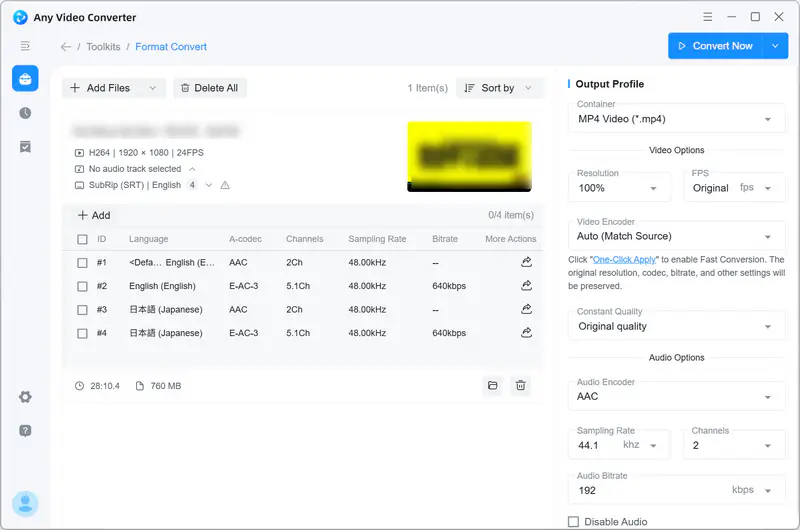
Step 1: Add your video files
Open Any Video Converter and add the video files you want to convert. For batch conversion, you can add multiple files or an entire folder at once.
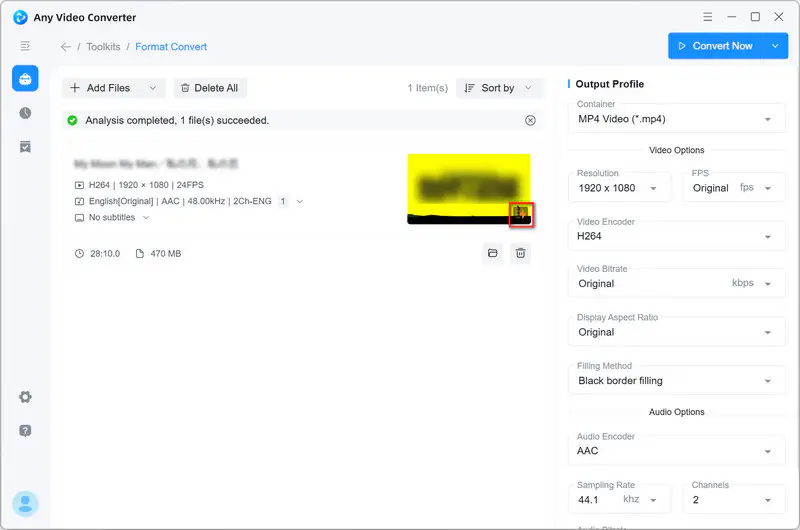
Tip: If a lightning icon appears on the video thumbnail, the file is eligible for Fast Conversion mode.
Step 2: Choose an output format
Choose the output format you need, such as MP4, MKV, MOV, or another supported format.
Step 3: Choose the right conversion mode
Fast Conversion Mode
Use Fast Conversion Mode when you want to keep the original resolution, codec, bitrate, frame rate, and other major parameters.
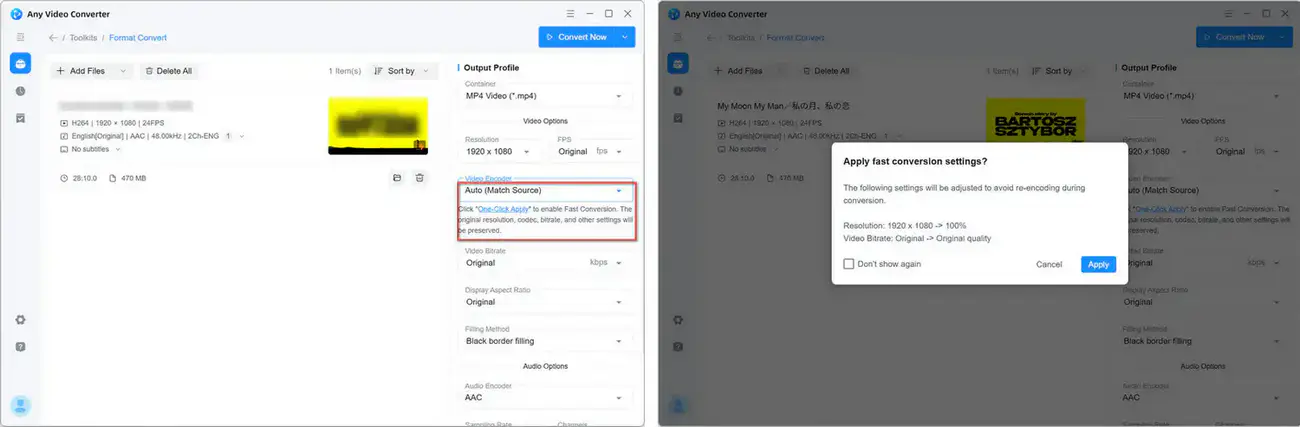
Under Video Encoder, choose Auto (Match Source). Then click One-click Apply to enable Fast Conversion mode. Review the prompt that shows which settings will be adjusted to avoid re-encoding, then click Apply.
This is useful because one incompatible output setting can turn a simple container change into a full re-encoding task.
GPU Acceleration
Use GPU Acceleration when the video needs to be re-encoded, such as when you change the codec (H.265 to H.264), compress the video, resize the video, burn subtitles into the video, or apply visual edits.
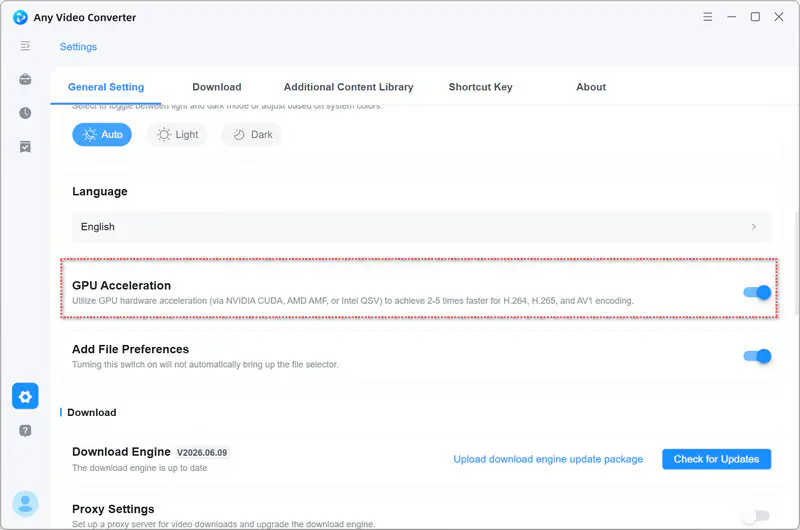
You can check whether GPU Acceleration is enabled in Settings → General Settings → GPU Acceleration.
Step 4: Start conversion and check the output file
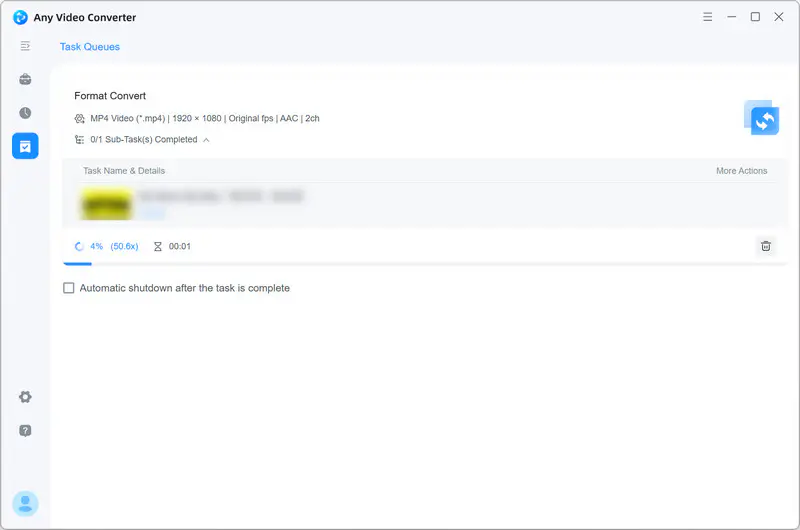
Click Convert Now to start the task. After conversion, check the output file if needed. If the file was re-encoded unexpectedly, review the output codec, bitrate, resolution, frame rate, and audio settings.
FAQs About Fast Conversion and GPU Acceleration
Is Fast Conversion the same as GPU acceleration?
No. Fast Conversion avoids re-encoding (keep the original video and audio settings) when possible, while GPU acceleration speeds up re-encoding when a new video stream has to be created.
Fast Conversion tries to keep the original video and audio streams, such as the codec, resolution, frame rate, bitrate, and audio settings. GPU acceleration is used when the video needs to be processed and encoded again.
Why can Fast Conversion be faster than GPU encoding?
Fast Conversion can be faster because it may skip the heaviest part of video conversion—re-encoding—and only change the container.
GPU encoding still creates a new video stream, even if it does the job faster than CPU encoding. Fast Conversion can keep the original streams and repackage them into a compatible output container, so the software has much less work to do.
When should I use Fast Conversion?
Use Fast Conversion when you only need to change the container and want to keep the original video quality and settings.
For example, it may be useful for MKV to MP4, MOV to MP4, or MP4 to MKV when the original codec, resolution, frame rate, bitrate, and audio format are compatible with the output format.
When should I use GPU acceleration instead of Fast Conversion?
Use GPU acceleration when the video must be re-encoded. This usually happens when you change the video codec, reduce file size, resize the video, lower the bitrate, burn subtitles into the video, or apply effects. These tasks require the software to create a new video stream.
Will Fast Conversion reduce video quality?
No, not when the original streams are kept. Fast Conversion does not introduce re-encoding quality loss because it avoids rebuilding the video stream. It does not improve the original quality, but simply preserves the original stream when the output settings are compatible.
How do I know if Fast Conversion is available in Any Video Converter?
If a lightning icon appears on the video thumbnail, it means this video may be eligible for Fast Conversion Mode.
Then you can choose Auto (Match Source) under Video Encoder and use One-click Apply to apply Fast Conversion settings that help avoid unnecessary re-encoding.
Why is my GPU not being used during conversion?
Your GPU may not be used if the task does not require GPU encoding, the selected output encoder is not supported by your hardware, GPU acceleration is disabled, or the graphics driver is outdated.
Sometimes the GPU is not the slow part of the process. The conversion may be waiting on the computer to read or write the file, decode the original video, process audio, or apply extra settings. In those cases, GPU usage may stay low even if GPU acceleration is turned on.
Tip: Before conversion, remove any audio or subtitle tracks you do not need. This may not always make video encoding much faster, but it can reduce unnecessary processing and help keep the output file smaller.
Does Any Video Converter support NVIDIA GPU acceleration?
Yes, Any Video Converter supports GPU acceleration technologies from NVIDIA, AMD, and Intel. When re-encoding is required, supported hardware acceleration can help reduce conversion time by using dedicated video processing capabilities instead of relying only on slower CPU encoding.
Conclusion
Fast video conversion does not mean using more hardware power. In many cases, the biggest time saver is avoiding unnecessary re-encoding to reduce more work. Any Video Converter makes this easier by showing a clear lightning icon when Fast Conversion is available, and by offering Auto (Match Source) to allow users to keep the original settings as much as possible. In conclusion, if the original streams can be kept, Fast Conversion is definitely worth trying first. If the video needs to be resized, compressed, or converted to another codec, GPU acceleration is still the better choice.
Try the Fast Conversion mode in Any Video Converter to experience faster and more efficient video processing.

Charlie Campbell | Content Writer
Charlie Campbell is an experienced technical documentation writer with a background in software development and a passion for emerging AI technologies. Dedicated to helping readers stay ahead in the fast-paced digital landscape, he combines technical expertise with clear communication to simplify complex topics and keep audiences informed on the latest advancements.